
Mayur Gavture – Nagpur
You can also publish your article on our Journal ( Send your article at this Mail joidconsultancy@gmail.com /Ph – 8617562543 WA-7584931893 )
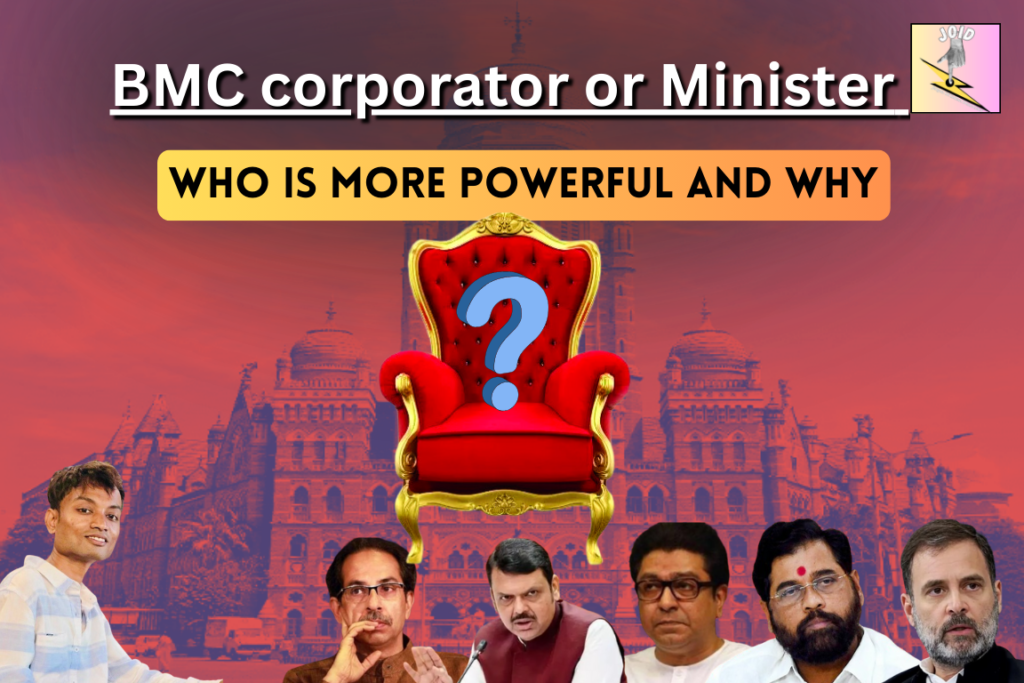
The Brihanmumbai Municipal Corporation (BMC) election is often misunderstood as a local, civic exercise. In reality, it is neither local nor purely political. It is an indirect corporate election, where the corporator is not just a public representative but a gatekeeper of power, money, permissions, and survival in India’s most expensive city. This is why, in Mumbai, a BMC corporator often matters more than most ministers and why this election is bigger than ministries and dirtier than conventional politics.
To understand the scale, one must first understand Mumbai. Mumbai is not governed by ideology; it is governed by economics, access, and networks. The BMC controls an annual budget of nearly ₹75,000 crore, larger than the budgets of several Indian states. This alone changes the nature of politics. When that much money flows through a single institution, elections stop being about speeches and start being about control.
A Mumbai corporator is not comparable to a corporator anywhere else in India. In many cases, they wield more day-to-day power than MLAs, MPs, and even some state ministers. Roads, water connections, drainage, building permissions, slum redevelopment, hawker regulation, garbage contracts, hospital access, school funding almost every aspect of daily life in Mumbai passes, directly or indirectly, through the BMC ecosystem. Ministers may announce policies, but corporators decide who gets what, when, and how smoothly.
This is why becoming a corporator in Mumbai is nearly impossible for outsiders. The entry barriers are brutal. It is not enough to have party backing or popularity. The game is about settlements, pressure management, negotiation skills, legal navigation, local muscle, and an aura of control. Over the last 7–8 years, candidates have reportedly spent ₹50–100 crore or more in a single ward, not just during election season but continuously on visibility, festivals, local events, dispute resolution, legal battles, and network maintenance.
Mumbai politics is outrageously expensive. Even basic campaigning banners, posters, flexes, hoardings, festival sponsorships costs multiples of what it would cost in any other city. Yet money alone is not enough. Ironically, despite such massive spending, reaching even 20–30 % voters directly can be extremely difficult. This is not because people are unreachable, but because voters themselves are disengaged from municipal politics. For most citizens, the BMC election does not trigger emotion, identity, or ideological loyalty the way Assembly or Lok Sabha elections do.
As a result, Mumbai’s municipal elections are not won through mass appeal but through micro-control. Buildings, housing societies, slum committees, shop-owner associations, religious trusts, NGOs, contractors, and informal local leaders matter more than rallies. Votes move through cooperative societies, chawls, redevelopment clusters, and local intermediaries. This is why the survival of a corporator depends less on party ideology and more on the efficiency of their assistants, fixers, and local networks.
In this ecosystem, political parties are often just brands. The real fight is not BJP vs Shiv Sena vs Congress it is lobby vs lobby, network vs network, builder group vs builder group. In the background, every caste, category, and economic interest group funds candidates, sometimes even funding rival candidates simultaneously. The objective is simple: ensure access to whoever wins. Ideology becomes irrelevant; proximity to power becomes everything.
Public issues corruption, potholes, housing, water, infrastructure exist, but largely as narratives for voters. Internally, very few actors pretend that these are the real drivers of the election. When a single municipal body controls tens of thousands of crores, morality becomes negotiable. The system rewards those who can manage conflict quietly, keep projects moving, and ensure that no stakeholder feels completely excluded.
Unofficially, it is widely believed that each corporator influences or oversees ₹1,500–2,000 crore per ward per year, directly or indirectly. This influence flows through contracts, sub-contracts, permissions, redevelopment projects, and service delivery. Add to this the informal 3% ecosystem that exists across Maharashtra’s political-administrative machinery, and the incentive structure becomes clear. This is why the BMC is often described quietly, off record as the most powerful municipal corporation in India, and arguably one of the most powerful in Asia.
This concentration of power explains why BMC elections attract corporate interest, silent investors, and long-term funding pipelines. For many players, this is not an election it is an investment. Returns are not measured in five years of salary or status, but in decades of access, leverage, and immunity.
In that sense, the BMC election is not about governance alone; it is about who controls Mumbai’s future. It decides who shapes redevelopment, who mediates between citizens and the state, who can apply pressure upward and downward, and who survives in a city where legality and reality often operate in parallel.
So how big is the BMC election?
It is bigger than most ministries because it controls more money and affects daily life more directly. It is dirtier than traditional politics because ideology is optional and power is transactional. And it is more consequential than many state or national elections because Mumbai runs through the BMC.
In Mumbai, power does not start in Mantralaya or Parliament. It starts at the ward office.
Our other articles : Leveling the Field: How First-Generation Politicians Can Compete with India’s Dynastic Class? | Political Messaging: The Invisible Architecture of Victory | Kailashpati Mishra: Bhishma Pitamaha of Bihar BJP | Bihar 2025: The Four-Way Showdown | The Unspoken Reality : Read This Before You Sign|Bihar 2025: The Four-Way Showdown | AAP in Bihar: Ambition, Experiment, or Emerging Alternative? | The Kavitha Factor : Telangana’s Shifting Politics | Why CPM failed to expand in Bihar Since its inception in 1964 | The Decline of CPI in Bihar Politics: From Vanguard to the Margins | The Quad As An Asian NATO | 100 Best Books of the 21st Century by The New York Times | How Bihar’s SIR Revision Threatens Congress’s Chances in Its Mission 58| From Sushasan Babu to Survival Babu | PK’s 2030 Gameplan | Does Bengal Have a PR Problem? | A scenario of “What ifs” in Bihar | German Chancellor Fellowship discussion |Mission 58: How Congress Plans to Flip Bihar | Bengal Bellwether – 2 | Bengal Bellwether – 1 | India United – India’s message is loud & clear on terrorism a diplomatic strike on terror| The Indian Stock Market is bleeding | SUPER NARI – 25 | Caste and the Ballot in Bihar | The suicidal mission of Pakistan’s so called ‘Establishment’ | Who is Responsible for Bihar’s Migration Crisis? | Why Congress must go solo in Bihar | Jai Bhim | Old is Gold , Resurrection of ‘Dynasty Politics’ | China Faces 125% Tariff by USA: A Strategic Opportunity for India | When the Accuser Becomes the Accused
Books that enriches – Westbengal Changing Colours Chnaging Challenges by Sitaram Sharma | India after Gandhi by Ramchandra Guha | Contesting democratic deficit by Salman Khurshid | The election that surprised India By Rajdeep Sardesai

Mayur Gavture is a Political Strategy Consultant and currently working as the legislative & Political Associate at the Office of Hon. Member of Parliament Shri Namdev Kirsan. He also has interests in Election Campaign , Legislative Policy – Advocacy & Governance Advisor.