

Pratimesh Karn – Patna
You can also publish your article on our Journal ( Send your article at this Mail joidconsultancy@gmail.com /Ph – 8617562543 WA-7584931893 )
The 2026 West Bengal Legislative Assembly elections, scheduled for March-April, will redefine the political trajectory of India’s most combative state. As the Trinamool Congress (TMC) and the Bhartiya Janata Party (BJP) prepare for what promises to be one of the most fiercely contested electoral battles in independent India, the political landscape reveals not a clear victor, but rather two formidable forces locked in an intense bilateral struggle where
victory will be hard-won for either party.
Introduction: The Stakes and the Scenario
West Bengal elections have never been merely provincial contests. They have always carried national significance, and the 2026 elections exemplify this principle more acutely than ever before. With 294 assembly seats at stake and a state population exceeding 100 million, West Bengal represents a crucial battleground in the BJP’s expansion strategy, while simultaneously testing Mamata Banerjee’s political durability against sustained institutional
pressure.
The 2021 assembly elections delivered a decisive mandate to the Trinamool Congress, which secured 215 seats with a vote share of 48.02 percent, while the BJP emerged as a distant second with 77 seats and 38.15 percent vote share[1]. Five years later, however, the political terrain has shifted considerably. The BJP’s confidence stems from its 38.73 percent vote share in the 2019 Lok Sabha elections, suggesting that with a modest 7-8 percent swing in voter consolidation, the saffron party could fundamentally alter Bengal’s political equation.
Yet, premature proclamations of BJP dominance would be analytically imprudent. The TMC’s entrenched grassroots infrastructure, Mamata’s calculated positioning as the state’s custodian against Brahminical centralism, and the absence of a credible opposition alliance within the INDIA bloc present formidable barriers to a swift BJP victory. This is a contest that willneither be uncontested nor conclusive—it will be bilateral, grueling, and mutually uncertain.
The Current Political Scenario: A Fragmented Opposition TMC’s Consolidation Strategy
The Trinamool Congress enters the 2026 fray from a position of governmental incumbency, which provides both structural advantages and inherent vulnerabilities. The party’s organizational machinery, developed over fifteen years of state governance, remains unparalleled in its reach and penetration into village panchayats and municipal corporations across Bengal.
Mamata Banerjee’s political acumen lies in her capacity to situate the TMC as the guardian of Bengali regional identity against perceived encroachments from New Delhi. This narrative gained particular resonance following her assertion of “importing fake Hinduism to the state” in response to BJP’s aggressive Hindu mobilization, signaling that the 2026 contest will be as much ideological as electoral.
However, the TMC faces substantial governance challenges. Allegations of administrative opacity, concerns regarding the electoral roll manipulation, and pervasive reports of grassroots intimidation have eroded the party’s popular legitimacy among sections of the urban middle class and civil society organizations.
The party’s Women’s Army has become emblematic of its welfare-centric approach, but this strategy must contend with rising expectations regarding institutional accountability and transparent governance.
The Congress and Left Conundrum
The Indian National Congress (INC) and the Communist parties present a historically significant but currently diminished political presence in Bengal. Following the INC’s repeated electoral debacles at both national and state levels, and the Left’s near-total marginalization after 2011, both parties confront existential questions regarding their contemporary political relevance.
The most significant development regarding the Congress is the categorical rejection of any seat-sharing arrangement with the TMC by Mamata Banerjee herself. TMC sources have explicitly stated that Mamata must lead any opposition consolidation, rendering the Congress either marginal or adversarial. For the Congress, the 2026 elections offer either a path to re-establish minimal presence or a further descent into irrelevance in India’s fourth-largest
state. The Left parties, represented primarily by the Communist Party of India (Marxist), occupy even more constrained political space. Their traditional social base has either migrated to the TMC (working-class constituencies in Kolkata) or the BJP (sections of rural voters responding to identity-based mobilization). The 2026 elections will likely witness a further erosion of Left electoral presence, possibly reducing them to negligible parliamentary representation.
The BJP Ascendancy: Opportunities and Constraints (Strategic Positioning and Grassroots Mobilization)
The BJP’s assertion that it will form West Bengal’s first-ever non-communist, non-regionalist government is not mere electoral rhetoric. The party’s organizational infrastructure has expanded substantially since 2019, with robust district networks and assertive cadre presence in rural constituencies previously considered TMC strongholds. The Rashtriya Swayamsevak Sangh (RSS) and Vishva Hindu Parishad (VHP) mobilization drives have successfully
converted the party’s 2019 parliamentary vote share into organizational momentum. The BJP’s strategic calculus rests on three pillars: First, consolidation of Hindu voters through a politics of religious identity and perceived institutional discrimination against Hindu interests. Second, mobilization of non-Bengali migrant populations, particularly from Bihar and Uttar Pradesh, whose cultural and economic integration into West Bengali society remains contentious. Third, leveraging central enforcement agencies (the Central Bureau of Investigation, Directorate of Revenue Intelligence, and Enforcement Directorate)
as implicit campaign instruments, creating a narrative of institutional reckoning against perceived TMC misgovernance. The appointment of Nitin Nabin as BJP National President in January 2026 carries tactical significance for West Bengal specifically. Nabin’s biographical profile—a five-time Bihar MLA with nearly two decades of political experience—suggests the BJP’s prioritization of organizational discipline and regional sensitivity[3]. Unlike his predecessor, Nabin representsa generational shift toward operational acumen rather than ideological oratory.
The Kayasth and Bihari Voter Calculus
Nitin Nabin’s identity as a Kayasth leader from Bihar introduces novel dynamics to West Bengal electoral politics, particularly regarding the Kayasth electorate and Bihari migrant populations. The Kayasth community, traditionally concentrated in professional, commercial, and administrative sectors across North India, has historically maintained a tenuous relationship with West Bengal’s dominant regional identity politics. The appointment signals the BJP’s recognition that electoral coalitions in 2026 must transcend purely Hindu nationalist framing and incorporate caste-based and regional community interests. Nabin’s elevation may facilitate improved BJP outreach among Kayasth voters in South Kolkata, traditionally middle-class constituencies where the party has shown
improved performance in recent cycles. Similarly, Bihar migrants in West Bengal—constituting an estimated 5-7 percent of the state’s population in major urban centers—face systematic social and economic marginalization in TMC-governed constituencies. The BJP’s emphasis on “cleaning up” governance through
centralized agencies offers these populations symbolic reassurance that their interests would receive more impartial institutional attention under a saffron government. Nabin’s Bihar background and linguistic facility with Hindi and regional dialects provide cultural authenticity that non-local BJP leaders cannot replicate. However, this strategy carries inherent risks. Excessive emphasis on Bihari and Kayasth voter interests may alienate the state’s Muslim and Christian populations, who comprise approximately 30 percent of Bengal’s electorate. The BJP’s calculated silence on minority concerns and its emphasis on Hindu consolidation could produce a backlash vote, particularly if TMC succeeds in framing such mobilization as inherently threatening to pluralism.
Electoral Arithmetic and Vote Share Scenarios (The 215-Seat Question)
The TMC’s 2021 victory margin of 215 seats represented an exceptionally dominant position, secured with 48.02 percent vote share in a multi-cornered contest. For the BJP to achieve victory in 2026, the party requires not merely seat gains but a fundamental realignment of the electoral equation. If the BJP achieves its 7-8 percent vote share improvement from 2019 to 2026, the party could plausibly reach 42-45 percent aggregate vote share. However, vote share and seat
conversion represent distinct electoral phenomena. The BJP’s concentrated strength in specific districts (particularly South 24 Parganas, East Midnapore, and Darjeeling) may not translate into sufficient seat gains to overcome TMC’s superior organizational distribution of voter strength across constituencies.
The crucial variable remains the Muslim and Christian vote. If these communities remain consolidated with the TMC as occurred in 2021 the saffron party would require an improbable 90+ percent consolidation of Hindu voters to achieve a clear majority. Conversely, even modest fragmentation of the Muslim vote (through Congress or AIMIM contests) could fundamentally alter seat conversions in the party’s favor.
The Bilateral Nature of the Contest Why Neither Party Faces a Smooth Path to Victory
The characterization of 2026 as a “tough contest” requiring prodigious effort from both parties reflects underlying structural realities that transcend mere campaign mechanics. For the TMC, the challenges are threefold: First, governance fatigue has manifest across urban constituencies. The party’s performance in managing Kolkata’s infrastructure, addressing water scarcity, and ensuring transparent municipal services has deteriorated, particularly in comparison to the Modi government’s performance in non-political infrastructure projects. Second, the accumulation of allegations regarding administrative corruption, particularly surrounding the Public Works Department and the state’s educational sector, has created an opening for anti-incumbency rhetoric that resonates with younger voters and professional classes who were enthusiastic supporters in 2016-2021. Third, the INDIA bloc’s fragmentation within West Bengal prevents the TMC from leveraging the opposition’s nationally unified narrative against the BJP. The explicit rejection of seat-sharing with the Congress represents a strategic gamble that Mamata’s personal brand can withstand a bilateral contest against the BJP without diluting anti-incumbency through
coalition politics.
For the BJP, the challenges are equally formidable: First, despite impressive organizational expansion, the party remains disadvantaged in electoral roll management and booth-level infiltration, where the TMC’s fifteen-year governance provides unmatched experience. Election Commission investigations into alleged booth-capturing and electoral roll irregularities during the 2026 special revision process suggest that both parties will contest the fundamental legitimacy of the electoral process itself. Second, the party’s dependence on Hindu identity mobilization creates a ceiling beyond which vote consolidation becomes increasingly difficult. Non-Hindu populations comprising 30+ percent of the electorate remain overwhelmingly hostile to the BJP’s ideological
framework, and aggressive Hindu consolidation may paradoxically energize counter-mobilization among these communities. Third, the BJP’s reliance on central agencies as implicit campaign instruments introduces legitimacy risks. While enforcement actions against TMC leaders demonstrate governmental
capacity, they simultaneously undermine the party’s claims to institutional impartiality and may be perceived by voters as evidence of political instrumentalization rather than genuine governance reform.
Competing Strategies: The Campaign Architectures (TMC’s Tactical Approach)
The Trinamool Congress will contest 2026 on an explicitly regional autonomy platform, positioning itself as Bengal’s defense against New Delhi-imposed homogenization. This strategy involves: Identity-based Consolidation: The party will simultaneously assert Hindu credentials while protecting Muslim interests, a delicate balancing act that requires nuanced communication. Mamata’s recent statements asserting her Hindu identity while criticizing
the BJP’s approach suggest the party seeks to neutralize Hindu nationalist rhetoric while maintaining minority community confidence.
Anti-centralization Narrative: The party will leverage legitimate grievances regarding federal power imbalances, resource allocation, and environmental policies (particularly concerning the Sundarbans region and coal mining expansion). The framing of central enforcement agencies as tools of political revenge, while containing elements of hyperbole, carries sufficient empirical support to resonate with middle-class constituencies traditionally skeptical of executive overreach. Welfare-centric Governance: The continuation and expansion of schemes such as the Women’s Safety and Welfare initiatives, agricultural support programs, and educational scholarships represent the party’s primary governance claim. For a substantial segment of rural and urban poor populations, these welfare provisions constitute the most tangible evidence of TMC governance utility. Administrative Continuity: Emphasizing the relative stability and developmental performance of the past fifteen years, the TMC will argue that regime change introduces unpredictability that could harm existing beneficiaries of state schemes and protections.
BJP’s Strategic Framework
The BJP’s 2026 campaign will rest on four interconnected strategic pillars: Institutional Cleansing Narrative: The party will position itself as harbinger of
transparent, merit-based governance, leveraging central agency investigations to reinforce the perception of TMC administrative misgovernance and corruption. This strategy depends upon the party maintaining plausible distance from enforcement actions while benefiting from their political consequences.
Development and Infrastructure Focus: The party will emphasize national investment in Bengal’s infrastructure, promising accelerated industrial growth, improved transportation networks, and institutional modernization. Comparisons with BJP-governed state (particularly Gujarat’s development trajectory) will anchor this narrative. Hindu Cultural Mobilization: Without abandoning Hindu nationalism entirely, the BJP will refine this approach to emphasize cultural revivalism and institutional respect for Hindu religious interests, rather than majoritarian dominance rhetoric. This calibration attempts to consolidate Hindu voters without triggering minority backlash. Regional Leadership Legitimacy: Nitin Nabin’s elevation and the party’s emphasis on grassroots organizational strength aim to counter the narrative that the BJP represents external imposition. By foregrounding regional leaders with demonstrated organizational
acumen, the party seeks to construct a locally rooted political alternative to Mamata’s personality-centric regime.
Unresolved Questions and Contingencies
The 2026 election’s outcome remains genuinely uncertain due to several unresolved variables: Electoral Roll Management: The special revision process initiated by the Election Commission remains contested, with both parties alleging irregularities. The final electoral roll composition will directly influence constituency-level arithmetic, particularly in constituencies where demographic composition has shifted due to migration patterns. Alliance Possibilities: While currently improbable, last-minute coalition formations either between the Congress and TMC, or between regional players and the BJP could fundamentally alter the electoral landscape in the final weeks. Issue Salience Shifts: Developments regarding environmental crises (particularly monsoon-induced flooding in the Sundarbans), economic disruptions, or major corruption exposures could shift voter priorities from identity-based to bread-and-butter concerns, altering the relative positioning of both parties. Minority Community Consolidation: The degree to which Muslim voters consolidate with the TMC versus the Congress versus abstention will directly determine the saffron party’s seat conversion efficiency.
Conclusion: A Bilateral Contest Without Clear Victors
The 2026 West Bengal Legislative Assembly elections will not be easily won by either the Trinamool Congress or the Bharatiya Janata Party. Both parties confront formidable obstacles, and both possess sufficient organizational and political resources to contest effectively for the state’s political future. The TMC enters as the incumbent with administrative machinery and Mamata’s consolidated personal brand, yet faces governance legitimacy questions and the absence of coalition partners who could amplify anti-incumbency against the BJP across specific constituencies. The party cannot rely on a fragmented opposition to ensure victory and must affirmatively demonstrate that its governance model remains preferable to the alternatives. The BJP possesses organizational dynamism, ideological coherence, and resource superiority, yet confronts the fundamental challenge that West Bengal voters have, across multiple
electoral cycles, rejected communal majoritarian politics and expressed preference for regionally rooted, albeit paternalistic, governance models. The saffron party’s triumph requires not merely mobilization of Hindu voters but genuine conversion of secular, minority, and regional identity constituencies toward acceptance of BJP governance. The contest will likely be decided by marginal variations in voter turnout in specific constituencies, the Election Commission’s success in managing contested electoral machinery, and the relative effectiveness of each party’s ground-level campaign organization. Neither party enters the contest with the certainty of victory that characterized Mamata’s 2021 triumph or the comprehensive organizational advantage that delivered Gujarat to the
BJP in recent elections. The 2026 Bengal elections will be contested fiercely, decided narrowly, and shaped by local contingencies that transcend both parties’ grand strategic narratives. The ultimate victor will be the party that best manages the delicate balance between national ideological imperatives and local political sensibilities a balance that neither the TMC’s regional particularism nor the BJP’s national ambitions currently embodies unambiguously.
Our other articles : Leveling the Field: How First-Generation Politicians Can Compete with India’s Dynastic Class? | Political Messaging: The Invisible Architecture of Victory | Kailashpati Mishra: Bhishma Pitamaha of Bihar BJP | Bihar 2025: The Four-Way Showdown | The Unspoken Reality : Read This Before You Sign|Bihar 2025: The Four-Way Showdown | AAP in Bihar: Ambition, Experiment, or Emerging Alternative? | The Kavitha Factor : Telangana’s Shifting Politics | Why CPM failed to expand in Bihar Since its inception in 1964 | The Decline of CPI in Bihar Politics: From Vanguard to the Margins | The Quad As An Asian NATO | 100 Best Books of the 21st Century by The New York Times | How Bihar’s SIR Revision Threatens Congress’s Chances in Its Mission 58| From Sushasan Babu to Survival Babu | PK’s 2030 Gameplan | Does Bengal Have a PR Problem? | A scenario of “What ifs” in Bihar | German Chancellor Fellowship discussion |Mission 58: How Congress Plans to Flip Bihar | Bengal Bellwether – 2 | Bengal Bellwether – 1 | India United – India’s message is loud & clear on terrorism a diplomatic strike on terror| The Indian Stock Market is bleeding | SUPER NARI – 25 | Caste and the Ballot in Bihar | The suicidal mission of Pakistan’s so called ‘Establishment’ | Who is Responsible for Bihar’s Migration Crisis? | Why Congress must go solo in Bihar | Jai Bhim | Old is Gold , Resurrection of ‘Dynasty Politics’ | China Faces 125% Tariff by USA: A Strategic Opportunity for India | When the Accuser Becomes the Accused
Books that enriches – Westbengal Changing Colours Chnaging Challenges by Sitaram Sharma | India after Gandhi by Ramchandra Guha | Contesting democratic deficit by Salman Khurshid | The election that surprised India By Rajdeep Sardesai
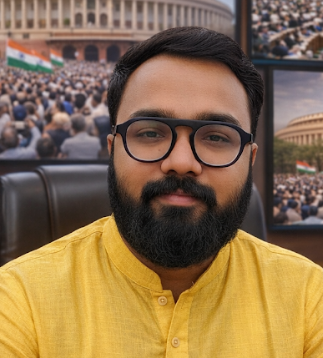
Pratimesh Karn is a political analyst and consultant based in Patna, Bihar, with extensive experience in Grassroot campaign, policy research and content creation.