
Shaleen Anand – Patna
You can also publish your article on our Journal ( Send your article at this Mail joidconsultancy@gmail.com /Ph – 8617562543 WA-7584931893 )
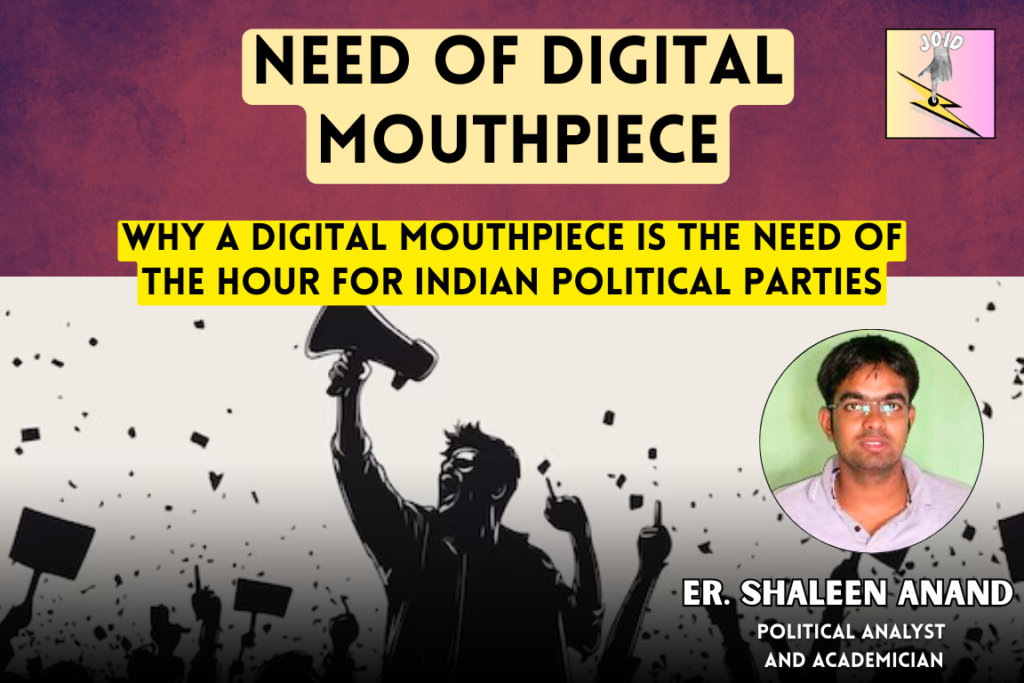
Why a Digital Mouthpiece Is the Need of the Hour for Indian Political Parties
Indian politics has always evolved alongside its modes of communication. From pamphlets and party newspapers during the freedom struggle to television debates in the post-liberalisation era, each phase has been defined by its dominant medium. Today, that medium is unmistakably digital. In this context, a digital mouthpiece—an official, professionally managed online platform representing a political party or group—has moved from being an advantage to a necessity.
The way citizens consume political information has undergone a fundamental shift. A rapidly expanding segment of the electorate, particularly first-time voters and smartphone users across urban and rural India, now relies primarily on digital platforms for news and political updates. Social media, websites, podcasts, and video channels influence opinion formation far more quickly than print or even television. Political parties without a structured digital presence risk marginalisation in the very spaces where public opinion is increasingly shaped.
A digital mouthpiece also enables parties to communicate directly with citizens. In a fragmented media environment driven by headlines, sound bites, and algorithmic amplification, political messages are often compressed or stripped of nuance. An official digital platform allows parties to articulate their policies, ideological positions, and clarifications in full, reducing reliance on intermediaries and limiting the scope for misrepresentation.
Equally important is the challenge posed by misinformation. The rapid spread of false narratives, manipulated content, and deepfakes has complicated democratic discourse. In such an environment, an authoritative digital voice becomes essential. A credible digital mouthpiece can respond swiftly with fact-based rebuttals, explanations, and context, helping citizens distinguish between verified positions and fabricated claims. For a democracy of India’s scale and diversity, this function is increasingly critical.
Beyond outward communication, digital platforms can also democratize internal engagement. Unlike traditional party mouthpieces that were often centralised and elite-driven, digital channels allow space for grassroots voices, regional concerns, and local achievements. They help parties remain connected with supporters between elections, strengthen organisational cohesion, and reflect a more representative political narrative.
That said, the growing importance of digital mouthpieces comes with corresponding responsibility. If such platforms are used solely for propaganda or become echo chambers that amplify hostility and misinformation, they risk deepening social polarisation. Credibility, transparency, and editorial discipline are therefore indispensable. Influence in the digital age is sustained not by volume or virality alone, but by consistency, accuracy, and accountability.
Finally, as governance itself becomes increasingly digital—through online service delivery, data-driven policymaking, and digital public infrastructure—political communication cannot afford to remain analog. Parties that fail to adapt may find themselves disconnected from both citizens and the evolving realities of governance.
In essence, a digital mouthpiece is not intended to replace independent media or suppress dissent. Rather, it reflects an adaptation to a transformed communication landscape. For Indian political parties and groups, embracing this shift is not merely a strategic choice; it is essential for remaining relevant, responsive, and responsible in a digital democracy.

Er. Shaleen Anand is a Political Analyst and Academician. He has worked with renowned political strategists Mr. Prashant Kishor and Chief Strategist of INC Mr. Sunil Kanugolu, and has also served as an Assistant Professor at a private university.