
Mayur Gavture – Nagpur
You can also publish your article on our Journal ( Send your article at this Mail joidconsultancy@gmail.com /Ph – 8617562543 WA-7584931893 )
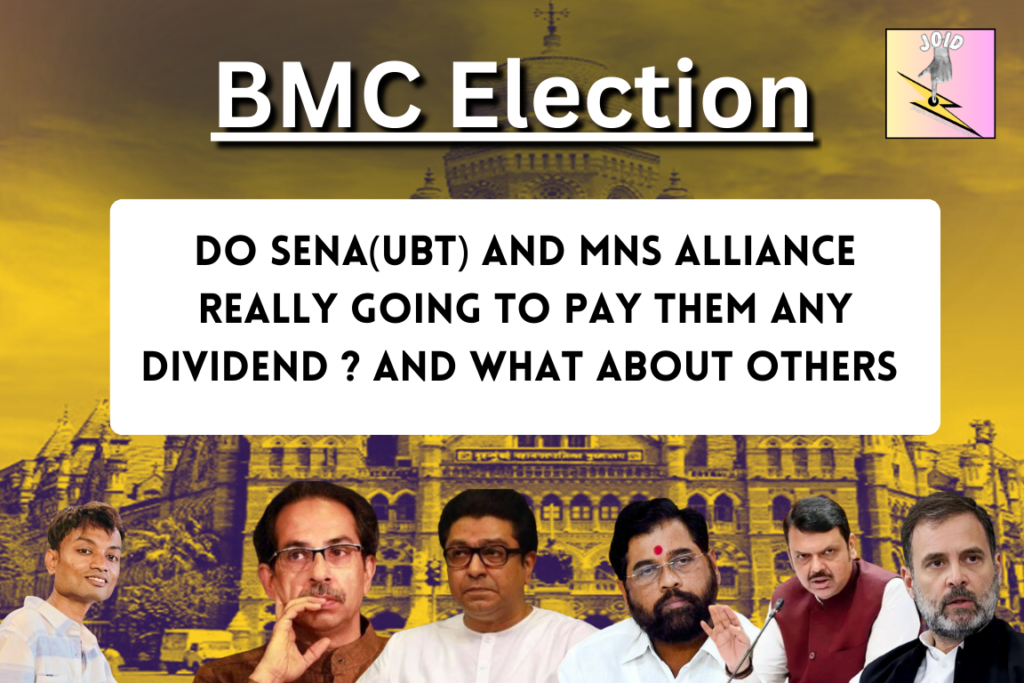
The emerging contours of the Brihanmumbai Municipal Corporation (BMC) elections suggest that Mumbai’s civic contest is being decided not by headline-grabbing alliances but by granular ward-level arithmetic, demographic consolidation and candidate credibility, with available opinion polls and surveys consistently placing the Bharatiya Janata Party (BJP) ahead of its rivals and on course to emerge as the single largest party in the 227-member civic body, even as no formation appears close to the majority mark of 114. The most striking takeaway from the data is that the much-anticipated Shiv Sena (UBT)–MNS understanding, while symbolically powerful in terms of Marathi asmita, does not automatically translate into seat accretion because the MNS organizational base is concentrated largely in wards where Sena (UBT) already enjoys strength, resulting in vote duplication rather than expansion, a pattern visible across South and Central Mumbai despite pockets of clean sweeps. In South Central Mumbai, Congress is projected to win 4–5 of the 7 seats in Dharavi, underlining its continued relevance in dense, minority-dominated urban clusters, while in the Wadala Assembly segment BJP holds Ward 177, Shinde-led Shiv Sena retains Ward 178 despite BJP’s higher popularity there and an estimated 60% combined Marathi backing for UBT–MNS, Ward 200 remains a close contest with a marginal UBT edge, and Ward 201 tilts toward Congress, reflecting the fragmented nature of three- and four-cornered fights. South Mumbai, by contrast, stands out as an exception, with surveys indicating a near clean sweep for the UBT–MNS combine across Wards 202 to 206, reinforcing findings that Marathi asmita continues to be a decisive, high-salience factor in this belt.
Historical data lends context to these trends. In the 2017 BMC elections, of the 227 corporators elected, 155 were Marathi and 72 non-Marathi, including 26 Muslims, 24 Gujaratis, 14 North Indians, five South Indians and three Christians; significantly, the BJP accounted for the largest share of non-Marathi corporators at 36, with 23 Gujaratis and 12 North Indians, a base that surveys suggest has remained largely intact and, in some suburban pockets, strengthened. This structural advantage is visible across large parts of the city. In Mahim Assembly, the UBT–MNS alliance is projected to sweep Wards 182 to 194, but this consolidation weakens as one moves northward. In Bandra West, Ward 100 is expected to be decisive, with Congress leading in Wards 97, 98, 99, 101 and 102, pointing to a likely 3–3 or 4–2 split rather than dominance by any single party. In North East Mumbai’s Shivaji Nagar Mankhurd belt, the contest remains sharply fragmented, with close fights between the Samajwadi Party (SP) and AIMIM in Wards 134 and 139, SP holding an advantage in Wards 136, 137, 138 and 140, BJP narrowly ahead in Ward 141, Shinde Sena in Ward 142, and Sena (UBT) locked in a tight contest with the Shinde faction in Ward 135, illustrating how local social composition, rather than alliance branding, determines outcomes.
Further north, Bhandup Assembly reflects a similarly split verdict, with BJP holding Wards 110 and 112, Sena (UBT) competitive or ahead in Wards 109, 113 and 114, and Shinde Sena retaining influence in Wards 115 and 116, while Mulund emerges as one of the BJP’s strongest zones, with surveys pointing to a clean sweep by the Mahayuti across all wards. In the North West Lok Sabha segment, Andheri East and West highlight BJP’s organisational depth in urban wards, with BJP leading in Wards 76, 80, 81, 67, 68, 69 and 71, Sena (UBT) competitive in select pockets such as Wards 75, 121, 74 and 77, and Congress retaining relevance only where candidate selection aligns with local demographics, notably in parts of Andheri West and Malad West. Dindoshi Assembly remains a key test case: while BJP approval ratings are high across most wards, Sena (UBT) is seen as capable of mounting a serious challenge if it fields the right candidate, underscoring the importance of local leadership over alliance arithmetic. Goregaon largely favours the BJP, though anti-incumbency against individual corporators creates vulnerabilities in a few wards, Malad West shows broad status quo with Congress holding ground and possibly gaining one additional seat, and Magathane marks a significant setback for Sena (UBT), with Shinde Sena and BJP benefiting from local dissatisfaction.
In the northern suburbs, the pattern becomes clearer. Borivali, Kandivali East, Charkop and Dahisar are projected to largely favour the BJP, with only isolated breakthroughs for Sena (UBT) or the Shinde faction, reinforcing the view that BJP’s urban-suburban consolidation remains its strongest asset. Demographic data further explains this advantage: surveys indicate overwhelming support for the BJP among North Indian voters from Uttar Pradesh and Bihar, with 73.5% of men and 78.77% of women backing the party and a majority favouring the BJP contesting the BMC elections on its own. At the same time, Marathi voters, particularly women, display strong loyalty to the UBT–MNS combine across age groups ranging from 68% to 78% placing overall Marathi preference at roughly 73% for Sena (UBT), 23% for Shinde Sena and 4% undecided, a distribution that would place the Shinde faction under severe pressure in a scenario where the BJP goes solo.
Muslim voters, who played a decisive role in earlier elections, appear unusually silent and undecided this cycle. Field interactions suggest a tactical approach: leaning toward Congress where it fields strong candidates, toward Sena (UBT) only in Congress-weak constituencies, and expressing comfort with Raj Thackeray’s alignment with Sena (UBT), even as the latter’s limited grassroots Muslim leadership constrains its ability to fully consolidate minority votes. Taken together, these ward-level and demographic trends place the BJP in the range of 85–95 seats, ahead of Sena (UBT) at 65–75, Shinde Sena at 30–40, Congress at 22–28, MNS at 8–12 and others in single digits, making the BJP the clear front-runner in Mumbai’s civic contest. The broader lesson from the data is unambiguous: in Mumbai’s BMC elections, alliances shape narratives, but it is ward-level arithmetic rooted in social composition, organizational strength and candidate choice that ultimately determines who leads the city’s most powerful municipal body.
Our other articles : Leveling the Field: How First-Generation Politicians Can Compete with India’s Dynastic Class? | Political Messaging: The Invisible Architecture of Victory | Kailashpati Mishra: Bhishma Pitamaha of Bihar BJP | Bihar 2025: The Four-Way Showdown | The Unspoken Reality : Read This Before You Sign|Bihar 2025: The Four-Way Showdown | AAP in Bihar: Ambition, Experiment, or Emerging Alternative? | The Kavitha Factor : Telangana’s Shifting Politics | Why CPM failed to expand in Bihar Since its inception in 1964 | The Decline of CPI in Bihar Politics: From Vanguard to the Margins | The Quad As An Asian NATO | 100 Best Books of the 21st Century by The New York Times | How Bihar’s SIR Revision Threatens Congress’s Chances in Its Mission 58| From Sushasan Babu to Survival Babu | PK’s 2030 Gameplan | Does Bengal Have a PR Problem? | A scenario of “What ifs” in Bihar | German Chancellor Fellowship discussion |Mission 58: How Congress Plans to Flip Bihar | Bengal Bellwether – 2 | Bengal Bellwether – 1 | India United – India’s message is loud & clear on terrorism a diplomatic strike on terror| The Indian Stock Market is bleeding | SUPER NARI – 25 | Caste and the Ballot in Bihar | The suicidal mission of Pakistan’s so called ‘Establishment’ | Who is Responsible for Bihar’s Migration Crisis? | Why Congress must go solo in Bihar | Jai Bhim | Old is Gold , Resurrection of ‘Dynasty Politics’ | China Faces 125% Tariff by USA: A Strategic Opportunity for India | When the Accuser Becomes the Accused
Books that enriches – Westbengal Changing Colours Chnaging Challenges by Sitaram Sharma | India after Gandhi by Ramchandra Guha | Contesting democratic deficit by Salman Khurshid | The election that surprised India By Rajdeep Sardesai
Mayur Gavture is a Political Strategy Consultant and currently working as the legislative & Political Associate at the Office of Hon. Member of Parliament Shri Namdev Kirsan. He also has interests in Election Campaign , Legislative Policy – Advocacy & Governance Advisor.