
Mayur Gavture – Nagpur
You can also publish your article on our Journal ( Send your article at this Mail joidconsultancy@gmail.com /Ph – 8617562543 WA-7584931893 )
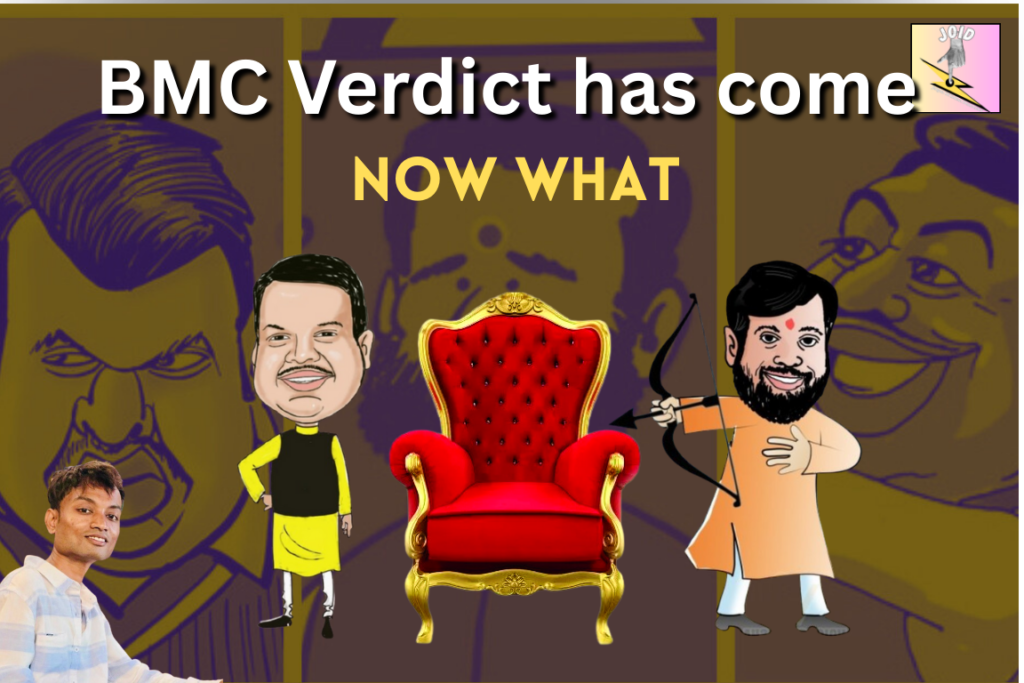
With the Brihanmumbai Municipal Corporation (BMC) election results now final, Maharashtra politics has entered a phase where the real contest begins after the ballots are counted. In this state, elections rarely conclude with results they transition into negotiations, pressure tactics, and strategic realignments. This is especially true when the prize is Mumbai India’s financial capital and the city that drives nearly 70% of the nation’s financial and corporate ecosystem. Control of Mumbai is not merely civic authority; it is political leverage at the national level.
The first major flashpoint following the verdict is the Mayor’s post. The BJP, buoyed by its numerical advantage, is pushing for the Mayor’s chair, while Eknath Shinde’s faction is demanding a 2.5-year rotational arrangement, a claim rooted more in political survival than arithmetic. Adding to the volatility is the reality that Shinde faction corporators are simultaneously engaging with both the BJP and Uddhav Thackeray’s Shiv Sena (UBT). Such fluid loyalties are not anomalies but features of Maharashtra’s political culture, where ambiguity itself becomes a bargaining tool.
At the core of this churn lies Mumbai’s unmatched importance. The BMC is not just a municipal body it controls infrastructure pipelines, real estate permissions, and enormous financial flows. Any party that dominates Mumbai gains disproportionate influence over corporate networks, media ecosystems, and long-term political financing.
That is why every major political calculation in Maharashtra eventually converges on the BMC. Beyond the state, the BMC outcome has also sharpened Devendra Fadnavis’s national profile. In the post-election landscape, he is increasingly viewed as a serious long-term contender in the BJP’s leadership pipeline, often mentioned alongside Amit Shah, Yogi Adityanath, and Himanta Biswa Sarma. Each represents a distinct political archetype Shah as the organisational and corporate face, Yogi as the core Hindutva standard-bearer dominant in Uttar Pradesh, and Sarma as a hard-edged regional power broker. Yet each also faces constraints of regional acceptance, internal resistance, or overreliance on polarisation.
Fadnavis, by contrast, occupies a different space. He projects a development-oriented,corporate-friendly, RSS-aligned image, with acceptability beyond Maharashtra and minimal internal opposition within the BJP.
Most of his internal rivals have already been neutralised; today, his only meaningful friction comes from Eknath Shinde, a rivalry sustained largely due to Amit Shah’s backing. As Sanjay Raut once put it, this is “Amit Shah’s Shiv Sena.” Notably, even during periods of intense political hostility, Uddhav Thackeray has largely avoided directly targeting Fadnavis, a restraint that suggests strategic calculation rather than coincidence.
In the aftermath of the BMC verdict, subtle political signals hint at a possible tactical thaw between Devendra Fadnavis and Uddhav Thackeray. There are no formal overtures, but Maharashtra politics often moves through quiet understandings rather than public declarations.
Even indirect or strategic voting during the Mayor’s election could open an unexpected political door especially given that there are no immediate major elections in Maharashtra, allowing space for recalibration without electoral risk.
Shinde’s position is further weakened by a practical constraint if the Mayor’s post falls under a reserved category (especially SC ) due to Supreme Court-mandated rotation,
his faction may not even have a viable candidate. This reality significantly erodes his bargaining power and strengthens the leverage of other players.
Ultimately, the BMC verdict has not settled Maharashtra politics it has activated it. The results have triggered a new phase of negotiations where Mumbai remains the ultimate prize and long-term positioning matters more than immediate optics.
In Maharashtra, alliances are rarely permanent, rivals can become partners, and silence often speaks louder than speeches. The ballots may have been counted, but as always, the real political film begins after the results because in this state, the credits never mean the end.
Our other articles : Leveling the Field: How First-Generation Politicians Can Compete with India’s Dynastic Class? | Political Messaging: The Invisible Architecture of Victory | Kailashpati Mishra: Bhishma Pitamaha of Bihar BJP | Bihar 2025: The Four-Way Showdown | The Unspoken Reality : Read This Before You Sign|Bihar 2025: The Four-Way Showdown | AAP in Bihar: Ambition, Experiment, or Emerging Alternative? | The Kavitha Factor : Telangana’s Shifting Politics | Why CPM failed to expand in Bihar Since its inception in 1964 | The Decline of CPI in Bihar Politics: From Vanguard to the Margins | The Quad As An Asian NATO | 100 Best Books of the 21st Century by The New York Times | How Bihar’s SIR Revision Threatens Congress’s Chances in Its Mission 58| From Sushasan Babu to Survival Babu | PK’s 2030 Gameplan | Does Bengal Have a PR Problem? | A scenario of “What ifs” in Bihar | German Chancellor Fellowship discussion |Mission 58: How Congress Plans to Flip Bihar | Bengal Bellwether – 2 | Bengal Bellwether – 1 | India United – India’s message is loud & clear on terrorism a diplomatic strike on terror| The Indian Stock Market is bleeding | SUPER NARI – 25 | Caste and the Ballot in Bihar | The suicidal mission of Pakistan’s so called ‘Establishment’ | Who is Responsible for Bihar’s Migration Crisis? | Why Congress must go solo in Bihar | Jai Bhim | Old is Gold , Resurrection of ‘Dynasty Politics’ | China Faces 125% Tariff by USA: A Strategic Opportunity for India | When the Accuser Becomes the Accused
Books that enriches – Westbengal Changing Colours Chnaging Challenges by Sitaram Sharma | India after Gandhi by Ramchandra Guha | Contesting democratic deficit by Salman Khurshid | The election that surprised India By Rajdeep Sardesai
Mayur Gavture is a Political Strategy Consultant and currently working as the legislative & Political Associate at the Office of Hon. Member of Parliament Shri Namdev Kirsan. He also has interests in Election Campaign , Legislative Policy – Advocacy & Governance Advisor.