
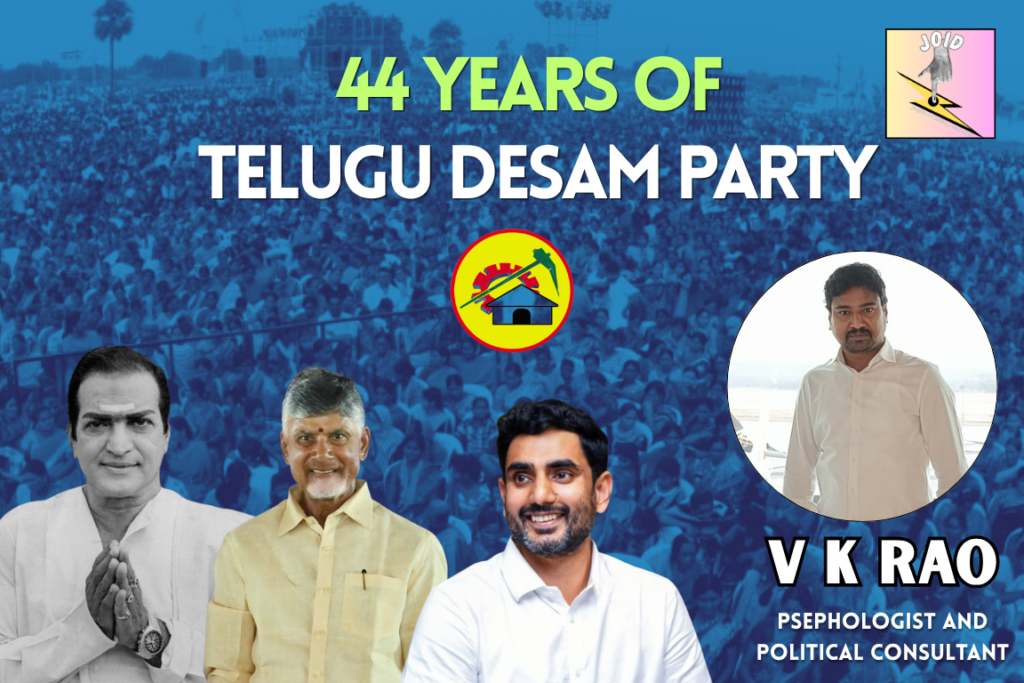
V K Rao – Psephologist and Political Consultant , Hyderabad
As someone who has had the opportunity to work with the Telugu Desam Party, this is not just an article for me — it is a reflection of a political journey that has shaped Andhra Pradesh, influenced national politics, and redefined regional assertion in India.
The story of TDP is not merely about a political party. It is about an idea — Telugu self-respect.
The Beginning: A Political Revolution (1982–1983)
The Telugu Desam Party was founded on March 29, 1982 by N. T. Rama Rao, at a time when Andhra Pradesh politics was dominated by a single national party. What made TDP extraordinary was the speed of its rise. Within just nine months, the party stormed to power in the 1983 Assembly elections, ending decades of Congress dominance. For me, this phase represents one of the greatest political mobilizations in Indian history — where emotion, identity, and leadership converged into a movement.
NTR Era: Welfare with Identity
NTR didn’t just build a party — he built a political philosophy rooted in dignity and welfare.
Key contributions included:
- ₹2/kg rice scheme for the poor
- Decentralization through Mandal system
- Women empowerment through property rights
- Telugu Ganga project and irrigation push
- Administrative reforms and anti-corruption stance
NTR combined populism with structural reform — something very few leaders have achieved.
Crisis and Transition: 1995 Turning Point
The internal political shift in 1995, where N. Chandrababu Naidu took over leadership, was a defining moment. Many see it as a crisis — but from a strategist’s lens, it was also a transition from charismatic politics to system-driven governance.
Naidu Era: Development, Technology & Governance
Under Nara Chandrababu Naidu, TDP transformed into a development-oriented, governance-driven party.
#Major highlights:
- Positioning Hyderabad as an IT hub (Cyberabad model)
- E-governance and administrative digitization
- Infrastructure expansion
- National political relevance (key role in NDA support)
Naidu brought a CEO-style governance approach — where planning, data, and execution became central.
Electoral Ups & Downs: A Resilient Organization
Like any long-standing political party, TDP has seen:
- Victory waves (1983, 1985, 1994, 1999, 2014, 2024)
- Setbacks (1989, 2004, 2009, 2019)
Despite this, TDP has remained one of the most resilient regional parties in India, consistently adapting to political changes. From my experience, the biggest strength of TDP is not just leadership — it is its cadre structure and organizational discipline.
Post-Bifurcation Phase (2014–Present)
After the bifurcation of Andhra Pradesh in 2014, TDP once again took responsibility of rebuilding a state from scratch.
- Formed government in residuary Andhra Pradesh (2014)
- Focus on capital creation (Amaravati vision)
- Infrastructure-led development approach
This phase tested the party’s administrative capacity and political endurance.
The New Generation: Transition to Future
Today, with leaders like Nara Lokesh emerging, TDP is entering a generational transition phase.
Recent efforts focus on:
- Cadre empowerment
- Youth engagement
- Ground-level restructuring
This signals a shift from legacy-driven politics to future-oriented organization building.
What TDP Represents Today
Having observed and worked within the ecosystem, I see TDP as:
- A movement born out of identity
- A party shaped by welfare and governance balance
- A structure-driven organization with strong cadre roots
- A political force that continuously adapts
The Core Strength: Cadre
One thing I’ve personally experienced: TDP is not just run by leaders — it is sustained by its cadre.” From booth-level workers to top leadership, the party has maintained a bottom-up political energy, which is rare in today’s politics.
Challenges Ahead
No honest analysis is complete without acknowledging challenges:
- Changing voter expectations
- Rise of welfare-heavy politics
- Competition from strong regional players
- Need for narrative reinvention
The future of TDP will depend on how it balances:
• Welfare vs Development
• Leadership vs Organization
• Legacy vs Innovation
44 years of TDP is not just a timeline — it is a case study in political evolution. From NTR’s emotional connect to Naidu’s administrative vision, and now to a new generation’s organizational push — TDP continues to evolve. As someone who has seen the party closely, I believe: “TDP’s strength lies in its ability to reinvent itself without losing its core identity.” And that is why, even after four decades, it remains not just relevant — but impactful.
VK Rao is a seasoned Political Strategist with more than a decade of experience shaping campaigns and narratives in Indian politics. He has advised four Chief Ministers and worked with both regional powerhouses in the Telugu states—TDP, BRS, YSRCP—and national parties including BJP and INC. Recognized for his expertise in grassroots operations and state-level strategy, he now serves as an independent consultant, offering grounded insights into the shifting political landscape of Andhra Pradesh and Telangana.